
Are you struggling to keep up with complex elder law documentation, tight deadlines, and growing client caseloads? Managing Medicaid applications, guardianship cases, and estate planning documents can quickly overwhelm your workflow and increase the risk of errors. Fortunately, an experienced Elder Law Paralegal can step in to handle these critical tasks, streamline your processes, and ensure your clients’ interests are fully protected.
In addition, a skilled paralegal can take on time-consuming responsibilities such as document preparation, client communications, and case tracking, freeing you to focus on strategy and high-value client work.
According to ParalegalEDU, an educational resource for aspiring paralegals and legal professionals, Elder Law Paralegals support attorneys who specialize in legal issues affecting elderly Americans, including estate planning, Medicaid planning, guardianship, and benefits claims.
They handle complex documentation, client interviews, and case coordination so you can focus on legal strategy and client advocacy.
Moreover, learn how an Elder Law Paralegal streamlines workflow and safeguards client interests to boost practice efficiency.
Lighten your caseload and boost your practice’s performance—schedule your consultation with a Virtual Elder Law Paralegal today to experience the difference.
What Are The Primary Responsibilities Of An Elder Law Paralegal?
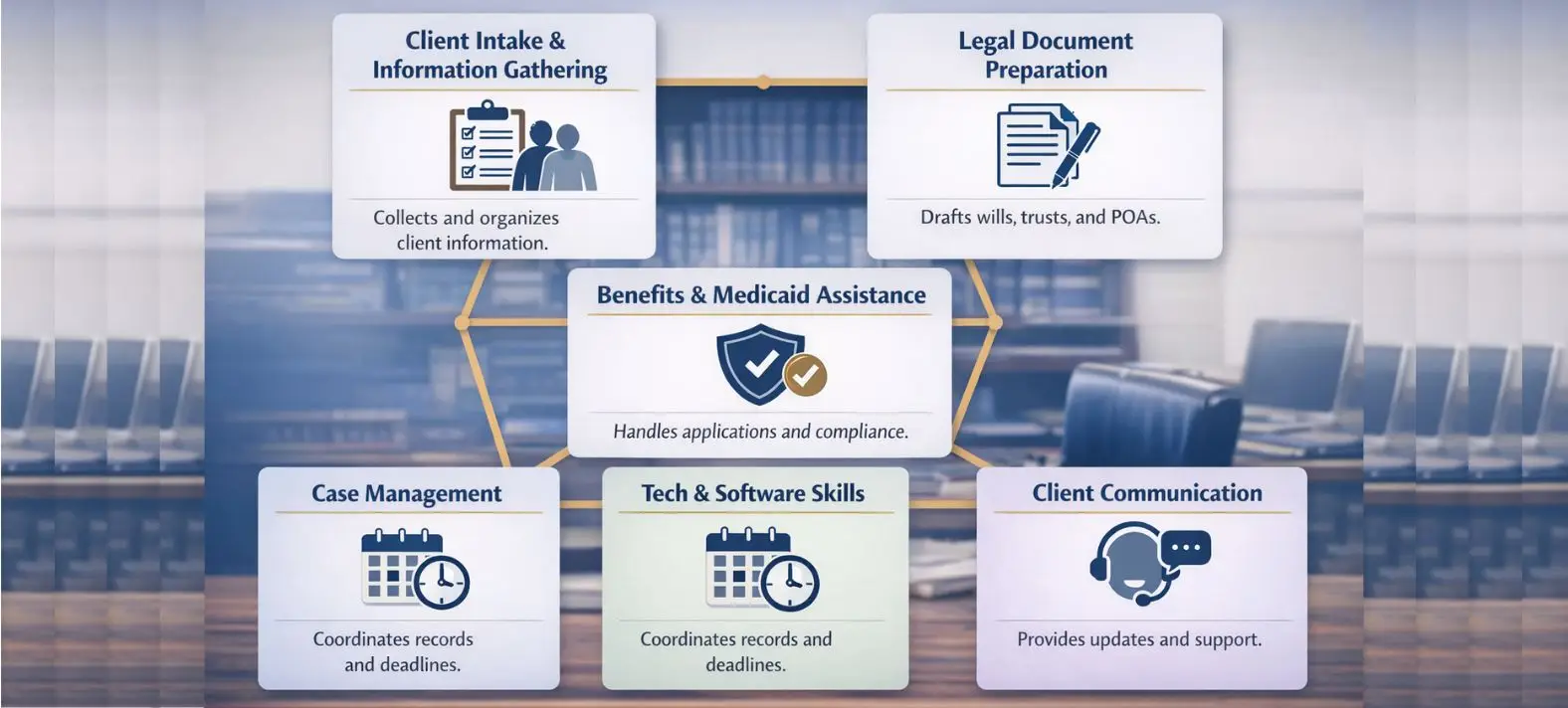
Understanding what an Elder Law Paralegal does is the first step in recognizing the value they bring. Core Responsibilities Include:
Client Intake And Information Gathering
First, Elder Law Paralegals interview clients and their families to collect essential facts, ensuring all relevant personal, financial, and medical information is documented.
They organize this data in virtual case management systems so attorneys can access it efficiently for legal strategy and case preparation.
Drafting Legal Documents
Next, paralegals prepare key legal documents, including wills, trusts, powers of attorney, advance directives (instructions for healthcare preferences if a client becomes unable to communicate), and healthcare proxies.
Their work ensures documents are accurate, compliant, and tailored to the client’s needs, reducing the risk of errors that could delay benefits or complicate estate planning.
Benefits And Compliance Support
According to NALA, an Elder Law Paralegal assists with the compilation and filing of applications for Medicare, Medicaid, and other benefits.
Moreover, they track deadlines, ensure documentation meets regulatory standards, and help with appeals if applications are denied, safeguarding client interests and reducing legal risk.
To maintain compliance, paralegals use standardized checklists and software tools that are continually updated with the latest regulations, ensuring accurate documentation and adherence to legal standards.
Regular audits and check-ins with attorneys reinforce compliance protocols and promptly address any discrepancies.
Case Coordination
Virtual Paralegals manage the organization of medical records, financial documentation, and inheritance information.
They handle scheduling, meet deadlines, and communicate with external parties, keeping cases on track and reducing administrative burdens for attorneys, as outlined in the Paralegal Job Description.
Client Communication
Elder Law Paralegals serve as a consistent point of contact for clients, providing updates on case status and clarifying procedural questions.
Their involvement ensures clients feel informed and supported throughout sensitive legal matters, as noted by Lawcrossing.
Finally, these core responsibilities establish the foundation. Next, let’s examine how these daily duties translate directly into stronger protections for your clients.
How Does An Elder Law Paralegal Protect Clients’ Interests?
Elder law clients often face sensitive personal and financial decisions—making precision and clarity critical. Here’s how a paralegal safeguards those interests:
1. Enhancing Accuracy And Compliance
First, Elder law involves intricate federal and state regulations. One such regulation is the ‘state Medicaid look-back period,’ which scrutinizes asset transfers and can affect Medicaid eligibility.
2. Safeguarding Confidential Information
In addition, confidentiality is mandatory. Paralegals handle privileged information with rigor, following strict protocols to protect client data from unauthorized disclosure.
Standard protocols, secure file storage, and encrypted communication maintain client confidentiality. This is part of strong legal operations and law firm financial management practices.
Regular audits ensure compliance with these protocols, providing attorneys with reassurance about data protection standards.
3. Anticipating Legal Needs Before They Become Problems
Furthermore, routine reviews of estate plans, trusts, healthcare directives, and benefits eligibility ensure updates are made proactively rather than reactively, helping protect against legal gaps, according to a Husch Blackwell study.
4. Serving As A Trusted Point Of Contact
Lastly, by building reliability and trust, Elder Law Paralegals amplify both technical and client service excellence. So, what abilities underpin their effectiveness?
What Skills Make An Elder Law Paralegal Effective?
The most impactful Elder Law Paralegals have a blend of technical and interpersonal skills:
Technical Skills
- Document drafting & legal research
- Knowledge of elder benefits systems
- Client file organization and case management tools
Interpersonal Skills
- Empathy and patience—critical with elderly clients
- Clear communication with clients and attorneys
- Diplomacy with family members and service providers
According to the NALA Paralegal Core Competencies list, effective paralegals combine technical proficiency, communication skills, and strong legal knowledge to support attorneys and deliver high‑quality legal services.
Skills To Look For In An Elder Law Paralegal
| Skill Area | Description |
|---|---|
| Legal Document Drafting | Prepares and drafts legal documents accurately. |
| Benefits Application Expertise | Handles benefits and assistance applications efficiently. |
| Case Organization Proficiency | Maintains well-organized case files and records. |
| Tech Fluency (Software & E-Filing) | Uses legal software and electronic filing systems confidently. |
| Empathetic Client Engagement | Communicates with empathy and professionalism. |
When Should You Hire An Elder Law Paralegal?
Consider hiring when:
- Your caseload restricts your responsiveness.
- Administrative work dominates your day.
- Clients complain about slow communication.
- You’re turning away new elder law cases due to capacity.
Hiring a virtual Elder Law Paralegal through legal staffing agencies like Wyzer Staffing can be especially strategic when you want:
- Rapid scalability
- Reduced overhead, a flexible workforce supporting peak workflows
Wyzer Staffing sets itself apart with specialized training programs for paralegals that ensure they are well-versed in the complexities of elder law.
Moreover, Wyzer offers flexible contract options that align with the fluctuating demands of your practice, allowing you to scale staffing resources as needed.
Overall, choosing Wyzer means investing in a partner committed to understanding and addressing the unique needs of your elder law practice.
Take the guesswork out of staffing your elder law practice—use our Staffing Calculator to plan the right team size for your caseload.
What Specific Risk Management Protocols Are Recommended When Delegating Sensitive Tasks To Virtual Staff?
To mitigate risk when delegating sensitive elder law tasks:
- Implement strict confidentiality agreements and secure data protocols.
- Use encrypted communication and secure cloud storage.
- Clearly define delegated tasks and responsibilities.
- Regularly audit work and maintain oversight.
- Provide ongoing training on compliance and ethical standards.
With these protocols in place, onboarding your new paralegal becomes a focused process. Let’s outline how to start your collaboration effectively.
How Can You Onboard An Elder Law Paralegal Smoothly?
Integrating a paralegal into your workflow doesn’t have to be disruptive. Use this simple onboarding framework:
Step 1: Introduce Office Procedures And Client Protocols
Provide a clear overview of your office workflow, client interaction standards, and confidentiality practices. This foundation helps the paralegal integrate smoothly into your practice.
Step 2: Define Clear Task Responsibilities
Outline the specific tasks, priorities, and expectations for the paralegal’s role. Legal task delegation ensures accountability and clarity from day one.
Step 3: Set Up Access To Case Management Systems
Grant access to your case management software, document repositories, and communication platforms. Proper setup enables immediate productivity and reduces errors.
Step 4: Schedule Shadow Sessions With Personnel
Have the paralegal observe the attorney and staff workflows to understand how tasks are executed. This hands-on learning builds familiarity and efficiency.
Step 5: Establish Routine Check-Ins And Feedback Cycles
Ultimately, regularly review the paralegal’s work, provide constructive feedback, and adjust responsibilities as needed. This ongoing support ensures alignment with your firm’s standards and client expectations.
Solid onboarding paves the way for effective supervision. How do you maintain compliance and quality with your virtual paralegal?

What Are Best Practices For Supervising Virtual Elder Law Paralegal To Ensure Compliance And Quality?
Supervising virtual Elder Law Paralegals requires clear communication, structured workflows, and regular check-ins. Therefore, best practices include:
- Establish clear task guidelines and deadlines.
- Use cloud-based case management tools to track assignments.
- Schedule consistent check-ins to review progress.
- Provide ongoing training on compliance and elder law regulations.
- Randomly review work to ensure accuracy and quality.
Consequently, following these practices not only sustains compliance and quality but also strengthens your client service—foundational benefits when partnering with a staffing solution like Wyzer.
How Can Wyzer Staffing Support Your Elder Law Practice?
Adding a virtual Elder Law Paralegal through Wyzer Staffing can streamline your workflow and client experience. Thus, Wyzer offers tailored solutions that align with your caseload and budget, enabling you to scale without hiring full-time staff.
Here’s How Wyzer Can Help:
- Virtual Legal Assistants: Handle document preparation, client intake, and routine communications, freeing your time for strategy and court work.
- Case Managers: Coordinate deadlines, medical records, and client follow-ups, ensuring nothing falls through the cracks.
- Paralegals: Support complex elder law cases, including estate planning, Medicaid planning, guardianship, and benefit applications.
Benefits For Your Practice:
- Significant time savings by delegating administrative and procedural tasks.
- Improved efficiency through structured workflows and expert handling of documentation.
- Higher client satisfaction thanks to timely communication and organized case management.
Moreover, Wyzer Staffing offers flexible options to suit practices of all sizes and needs. Costs typically depend on experience, specialization, and the number of hours required. Discover how virtual staffing can provide your practice with cost-efficient access to expert support—contact us today to learn more.
Wyzer provides highly qualified virtual staff, including paralegals, legal assistants, and case managers, to support your elder law cases. So, get expert assistance, improve efficiency, and ensure your clients receive the care and attention they deserve.
FAQs About Elder Law Paralegal
2. Does Hiring A Paralegal Increase Ethical Risk?
No, if you implement strong workflows and effective supervision. Paralegals work under an attorney's direction and follow strict confidentiality and conflict-checking procedures. Establishing regular check-ins, creating clear task guidelines, and using task-tracking tools can ensure that paralegal work is managed effectively and complies with legal standards.
3. What’s The Difference Between A General Paralegal And An Elder Law Paralegal?
Elder Law Paralegals specialize in benefits, guardianship, healthcare directives, and elder protection matters—areas not always covered deeply by generalists.
4. How Do Clients Perceive Paralegal Involvement?
When paralegals improve response times and clarity, clients often express higher satisfaction and feel better supported during complex legal journeys.
5. How Quickly Can A Virtual Paralegal Be Integrated Into An Existing Elder Law Practice?
Integration speed depends on your practice’s systems and workflow. With Wyzer Staffing, virtual paralegals can often start within days to a few weeks. Structured onboarding, access to case management systems, and defined responsibilities streamline the process, allowing your paralegal to become productive quickly.
Conclusion
In conclusion, an Elder Law Paralegal is more than an assistant—they’re a strategic partner who protects your clients’ interests with precision, compliance, and compassionate client engagement.
Thus, bringing this expertise to your practice boosts efficiency and client satisfaction while reducing your administrative burden.
Contact Wyzer Staffing now and elevate your elder law practice today with the right professional.
Discover more from Wyzer Staffing
Subscribe to get the latest posts sent to your email.