

What Makes a Strong Law Firm Business Plan the Foundation of Every Successful Practice?
Most attorneys leave law school skilled in law, not business. This gap leaves many solo and small-firm attorneys overwhelmed, undercharging, or stuck in reactive work rather than growing intentionally.
A law firm business plan details your services, finances, ideal clients, and support structure in a single resource.
This guide is practical whether you’re starting fresh or updating an established firm. Step by step, we cover each component, then move you directly into action with checklists, examples, and advice drawn from attorneys’ real-world experience. Next, outline what you can expect to gain from this resource.
What you’ll get from this guide:
- Clarity on your services, clients, and revenue goals
- A simple financial framework you can build in a day
- Workflow systems that protect your time and reduce burnout
- Guidance on when and how to bring in support
- Tools, templates, and CTAs to move you forward
Ready to delegate more tasks? Schedule a complimentary call with Wyzer Staffing using our booking link to discuss your firm’s needs. Discover how a trained virtual paralegal can begin supporting your practice as early as this week. Book your free consultation today.
What Should You Consider Before Writing Your Law Firm Business Plan?
Before you open a blank document, take time to think through these foundational questions. Consequently, your answers will shape every section of your plan.
Taking even 30 minutes to write your answers before drafting your plan will save you hours of back-and-forth later.
6 Steps to Write a Law Firm Business Plan That Actually Works
Step 1: Define Your Mission, Vision, and Legal Services
Your mission explains why your firm exists and who it serves, while your vision outlines your direction over the next 3 to 5 years. Additionally, these guide your decisions, pricing, communication, and team building. Therefore, avoid generic language; specificity creates clarity.
Mission example: “To provide practical, accessible family law services to working parents in central Florida who need clear guidance — not confusion.”
Vision example: “To build a virtual-first family law firm that handles 40 cases per month with a lean remote team, allowing clients and attorneys to work flexibly.”
Once your mission is clear, define your services with equal intention. Moreover, vague service lists confuse clients and hinder marketing. Clear firms — especially solo or small — get more referrals.
Ask yourself:
- Which services do you enjoy doing?
- Which services generate the most revenue per hour of your time?
- Which services could be delegated to a trained paralegal or handled through templates?
Additionally, structuring your services this way helps onboard new clients, set expectations, and identify delegable offerings.
Step 2: Identify Your Ideal Client and Research Your Market
According to the 2024 Legal Trends Report from Clio, many law firms fail to clearly define an ideal client — casting too wide a net and missing their best opportunities. Specificity is the goal.
Build a client profile that includes:
- Demographics: Location, age range, household income, primary language
- Legal problem: What specific issue are they trying to solve?
- Decision-making behavior: Do they respond to online reviews or word of mouth?
- Budget: Are they price-sensitive? Do they prefer payment plans?
- Communication style: Do they want frequent updates or minimal contact?
For example, Sample Ideal Client Profile: Name: Maria — Spanish-speaking single mother in Orlando, FL. Legal need: Custody modification after relocation. Budget: $2,500–$4,000; interested in payment plans. How she searches: Google + Facebook community groups + referral from a friend. Communication preference: Text updates, bilingual support preferred.
With a clear client profile in hand, research your competitive landscape — not to copy others, but to find the gaps they’re leaving open.
Where to research:
- Google your practice area + city and review the top 10 results
- Read competitor websites and note how they describe services and pricing
- Check Google reviews to see what clients praise — and what they complain about
- Attend local bar events and ask what firms are struggling with
Moreover, assess these points: Other firms offer virtual services? Underserved language communities present? Competitors slow on intake? Gaps equal opportunity.
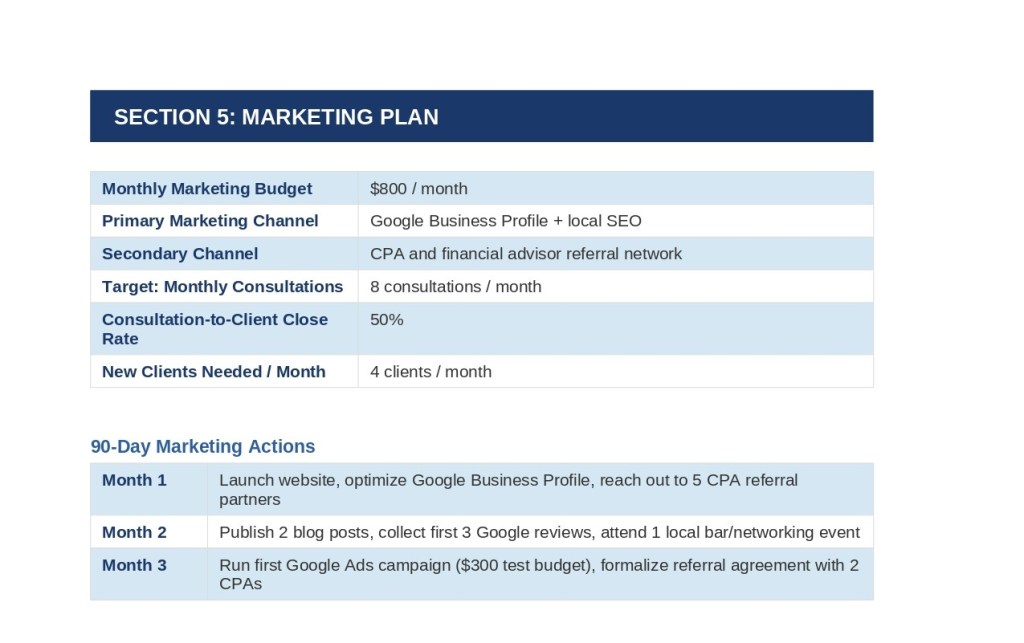
Step 3: Build a Realistic Marketing Plan
You do not need to be on every platform. Therefore, you need to be consistent with the right ones for your audience.
Core marketing actions to include in your plan:
- Website: Clear services page, attorney bio, testimonials, and a simple intake form
- Google Business Profile: Fully optimized with photos, hours, and updated reviews
- Content: One blog post per month answering common questions in your practice area
- Reviews: A simple process to ask satisfied clients for Google reviews
- Referral network: Identify five professionals (CPAs, financial planners, social workers) who serve your ideal client and build a referral relationship
Step 4: Create a Law Firm Financial Plan
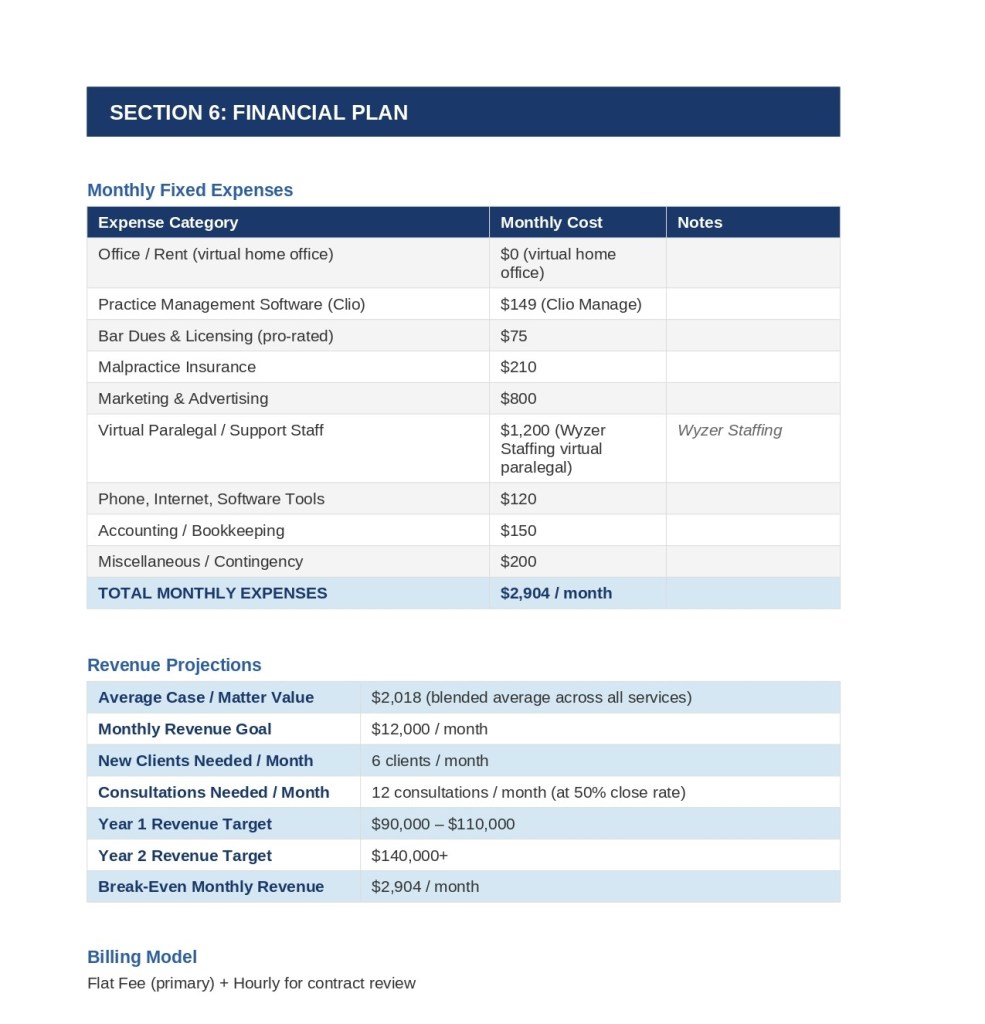
This is the section most attorneys dread — and the one that matters most for long-term sustainability. However, you don’t need a finance degree. Additionally, focus on three elements: costs, revenue targets, and a basic tracking system.
Understanding your Law Firm Finances early makes it easier to set realistic revenue goals and avoid financial surprises as your practice grows.
Calculate your fixed monthly costs — rent (if applicable), software subscriptions, bar dues, insurance, marketing, and staffing.
Calculate how many clients you need. If your average case value is $2,500 and your monthly revenue goal is $10,000, you need 4 new paying clients per month. If your consultation-to-retention conversion rate is 50%, you need to book 8 consultations per month. Therefore, this math tells you exactly what your marketing needs to produce.
Choose your billing model — hourly, flat fee, retainer, or a hybrid — and document it clearly. Moreover, your law firm billing structure influences marketing, client value perception, and cash-flow predictability.
Moreover, law firm financial management helps attorneys understand cash flow, forecast growth, and guide hiring and expenses.
Step 5: Map Your Operations and Delegate Strategically
Operational clarity separates scalable attorneys from those who burn out. Map your workflow before hiring or buying new software.
Key systems to define:
- Client Intake: How does a prospect first contact you? Who responds and within what timeframe? Does your consultation qualify the client before you invest time?
- Document Management: Where do client files live? Do you have templates for common documents, or is everything created from scratch?
- Calendaring and Deadlines: How are court deadlines tracked? Do clients receive reminders automatically?
- Billing and Collections: When are invoices sent? How are overdue accounts followed up on?
Additionally, identify the non-billable tasks eating your week—formatting documents, sending invoices, answering routine client questions, scheduling, data entry, and legal research on standard matters. Consequently, most solo attorneys spend 10–15 hours per week on non-billable work.
Every hour spent on administrative work is time that could otherwise be devoted to client service and generating additional billable hours.
According to the 2024 Legal Trends Report, many US law firms are losing significant revenue from billable hours spent on administrative tasks. Consequently, a trained virtual paralegal can manage much of this at a lower cost.
Spending too many hours on tasks that don’t require your law license? Wyzer Staffing connects attorneys with experienced, US-trained virtual paralegals who handle document prep, intake, billing, and admin — so you can focus on clients.
Step 6: Set Goals, Do a SWOT Analysis, and Write Your Executive Summary
SWOT Analysis
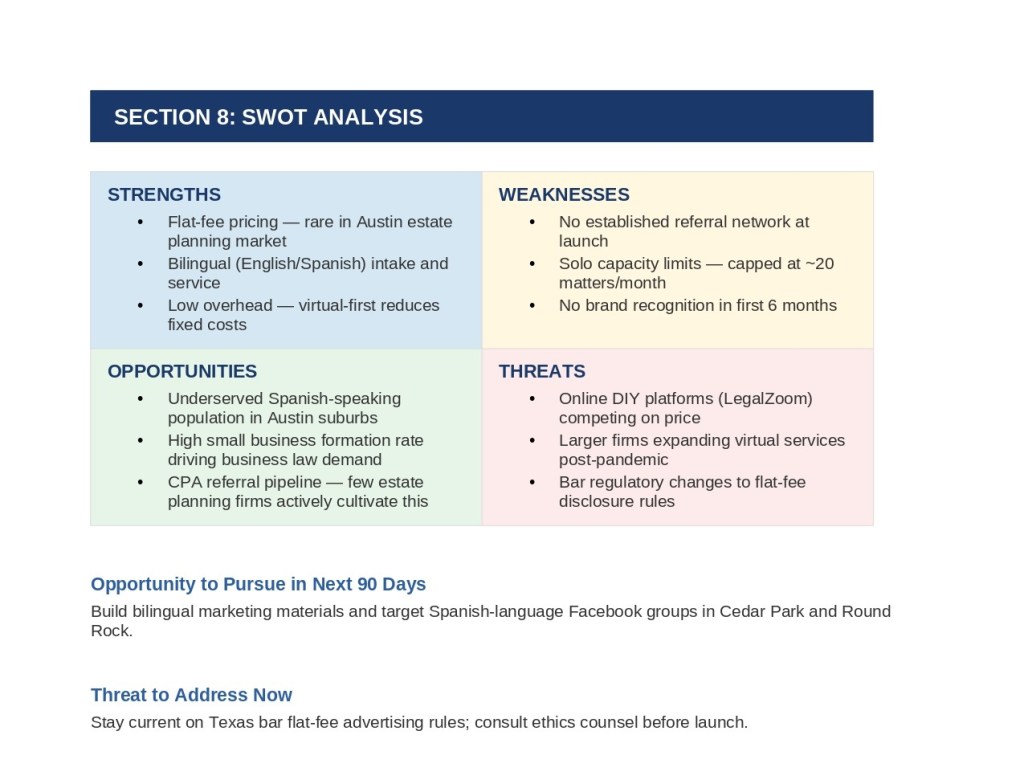
A SWOT analysis (Strengths, Weaknesses, Opportunities, Threats) gives you an honest picture of where your firm stands today.
- Strengths → lean into these in your marketing and positioning
- Weaknesses → prioritize fixing the ones that affect revenue or client experience first
- Opportunities → identify one or two to pursue in the next 90 days
- Threats → build contingency plans, especially for regulatory changes in your area
Goal-Setting with Measurable Milestones
Vague goals don’t move practices forward. Specific, time-bound milestones do. Additionally, set 30-, 60-, and 90-day targets and track these KPIs monthly.
- Total consultations booked
- Consultation-to-client conversion rate
- New client revenue and average case value
- Hours spent on non-billable tasks
- Outstanding accounts receivable
Additionally, set a recurring monthly review — even 30 minutes — to check your numbers and adjust your plan.
Executive Summary
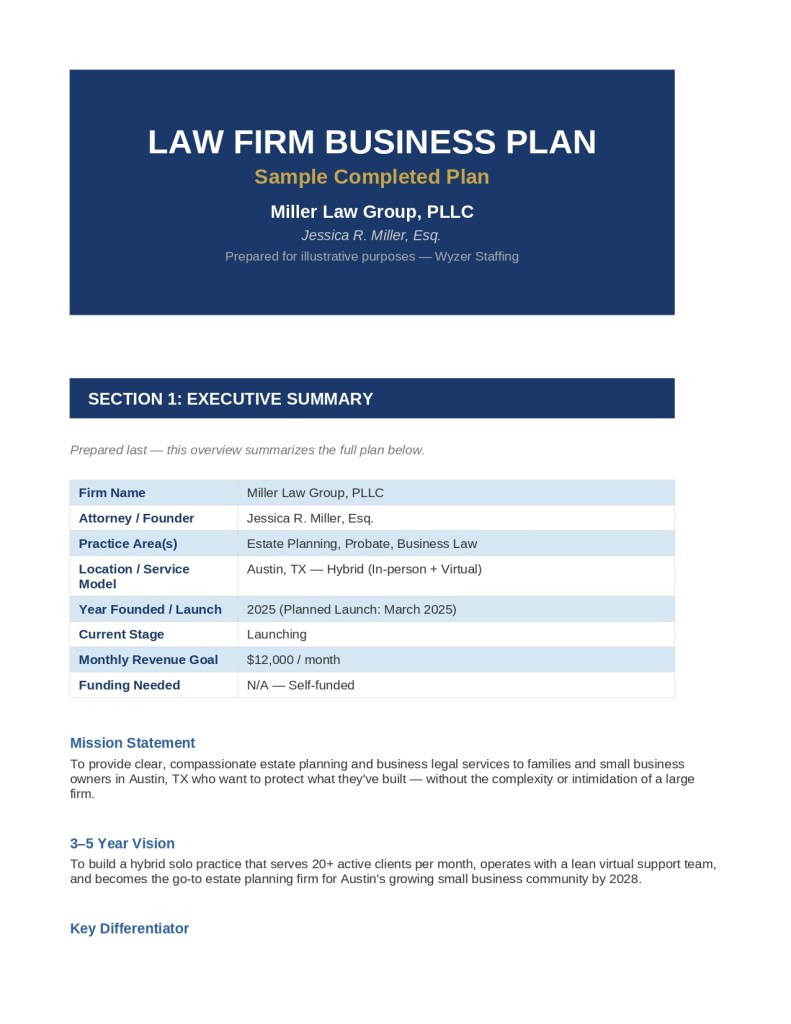
The executive summary goes first in your business plan but is written last. Moreover, it serves as a concise one-page overview designed to quickly communicate your practice to lenders, mentors, referral partners, or future hires. Additionally, include your mission, vision, primary practice areas, target client profile, revenue goal, differentiation, current stage, and funding you seek.
Actual Law Firm Business Plan Sample




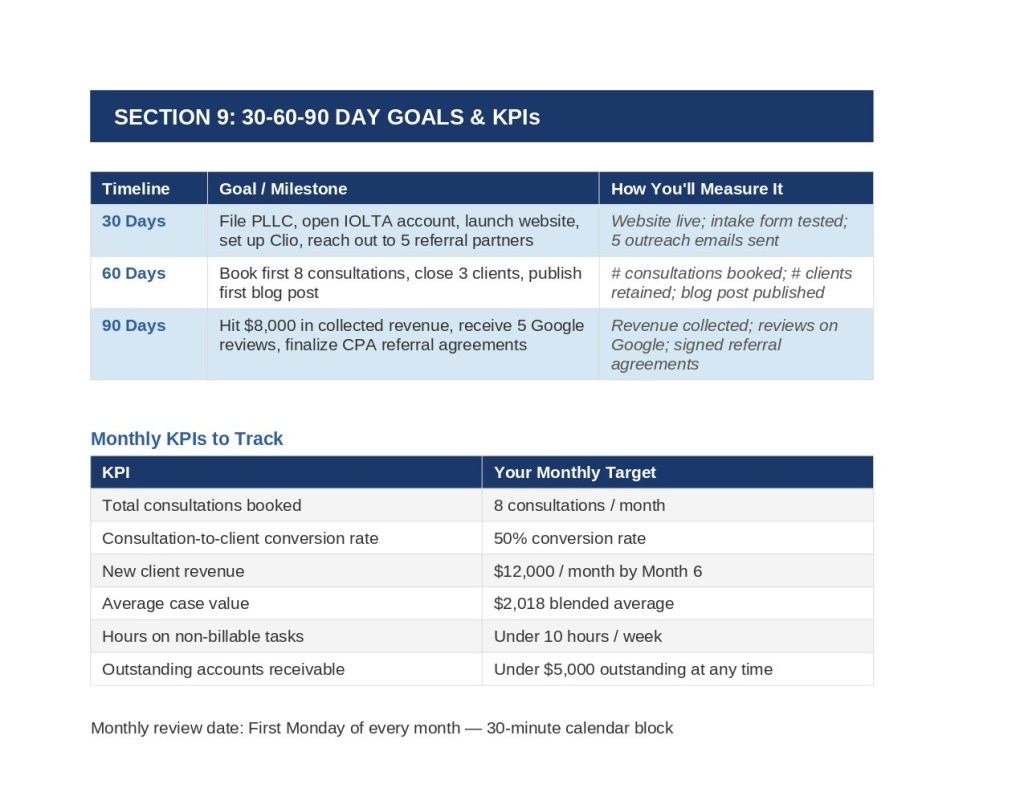

Other Law Firm Business Plan Resources and Templates
If you want to see how other firms have structured their plans before drafting your own, these resources offer useful starting points:
- Wy’East Law Firm Plan — a real-world example of a full firm plan
- DC Bar Practice Management Resources (PDF)— templates and guidance for attorneys at all stages
- Smith & Jones, P.A. Example (Biztree) PDF— downloadable plan template with financial sections
Why Attorneys Choose Wyzer Staffing To Build Stronger Practices?
Wyzer Staffing isn’t a temp agency or gig platform. Moreover, we specialize in long-term staffing for solo and small law firms, matching attorneys with virtual paralegals who understand workflows.
What Wyzer virtual paralegals can handle:
- Case preparation and document drafting
- Client intake and consultation scheduling
- Invoice creation and payment follow-ups
- Legal research on routine matters
- Email and calendar management
- Court filing and deadline tracking support
Why it works:
- No long-term in-house commitment
- Flat monthly pricing — no surprise invoices
- Pre-vetted professionals with legal industry experience
- Scalable — add support as your caseload grows
Stop doing everything alone. Your practice deserves a support system. Book your free consultation with Wyzer Staffing and find out how a virtual paralegal can free up 10+ hours of your week — starting this month.

FAQs About Law Firm Business Plan
2. How Long Should My Law Firm Business Plan Be?
Most effective plans for solo or small firms run 5–12 pages. Longer isn't better. Clarity is better. A plan you'll actually read and update quarterly is worth far more than a polished 40-page document that sits in a drawer.
3. How Often Should I Update My Business Plan?
Review it quarterly. Update sections that are no longer accurate — especially your financial projections, service menu, and team structure. Major updates (new practice area, new market, new hire) warrant an immediate revision.
4. When Should I Hire Help?
If you're spending more than 8–10 hours per week on tasks that don't require your legal expertise, it's time. A virtual paralegal is typically the first support hire for solo attorneys — lower cost than an associate, immediately productive, and scalable.
5. What If I Can't Afford to Hire Yet?
Start with automation. Tools like Clio Grow, Lawmatics, and Calendly can reduce your admin burden significantly before you hire anyone. Once your revenue grows, your support hire effectively pays for itself.
Conclusion
Your business plan doesn’t need to be perfect to be useful. Moreover, it should be honest, specific, and revisited regularly.
To begin with, start with what you know. Additionally, fill in the gaps as you learn. Update it when your practice changes direction. And when you’re ready to stop being the attorney, the admin, the marketer, and the bookkeeper — all at once — Wyzer Staffing is here to help you build the support system that matches where you’re going.
However, the attorneys who build sustainable practices don’t do everything themselves. Furthermore, they build systems, delegate strategically, and stay focused on the work only they can do.
Your business plan is the first step. The next one is yours to take. Contact us today!
Discover more from Wyzer Staffing
Subscribe to get the latest posts sent to your email.